What is the metabarcoding tool assembly?
The metabarcoding tool assembly gives a detailed overview of metabarcoding data management and complements the Biodiversity domain page. It aims to provide solutions to the challenges encountered in the life cycle of metabarcoding data. This page considers the following main data types:
- Sample metadata
- Sequencing reads (raw data)
- Curated occurrence data
- Curated sequence and taxa tables
Metabarcoding sequencing reads are processed into two major types of occurrence tables. Operational Taxonomic Units (OTUs) are generated by clustering reads based on sequence similarity [1], while Amplicon Sequence Variants (ASVs) are resolved at the single-nucleotide level without any clustering step, enabling finer taxonomic resolution and greater comparability across datasets [2]. The coexistence of these two output types is one of the major challenges in managing metabarcoding data.
The main challenges that are specific to metabarcoding are:
- the lack of a universal, community-accepted standard for ASV/OTU tables and of a repository dedicated to them (several institutions are developing solutions, which are mentioned on this page);
- the identification bias of reference databases, which is inherent to the fact that only what is already known can be identified.
How to access the metabarcoding tool assembly?
All the tools presented in this tool assembly are free, publicly available and mostly open source. Often registration is required to submit data.
What can you use the metabarcoding tool assembly for?
This tool assembly provides guidance and tool recommendations for each stage of the metabarcoding data life cycle: Planning, Collecting, Processing and Analysing, Preserving, Sharing and Reusing. Each stage is described below Figure 1.
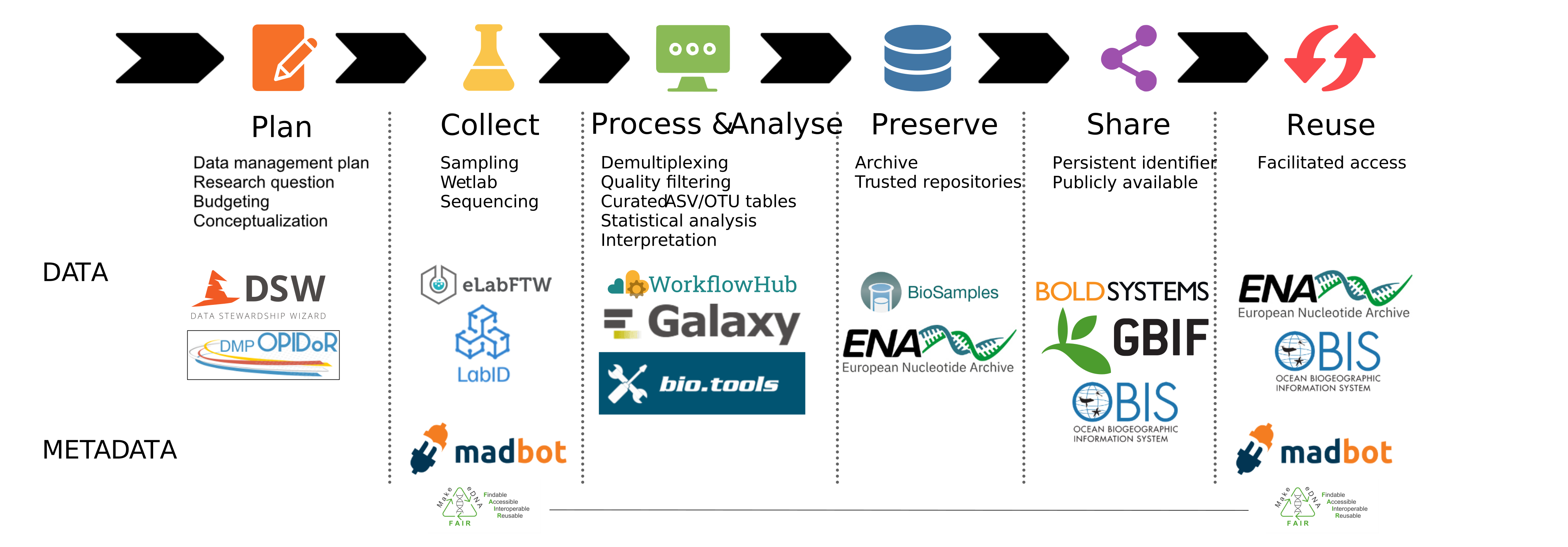
Figure 1. The metabarcoding tool assembly: tools and resources for data and metadata at each stage of the data life cycle.
Data management planning
As described on the Biodiversity domain page, a Data Management Plan (DMP) centralises all the information about a study. You can write it using the Data Stewardship Wizard (DSW) or any other platform that follows the Research Data Alliance (RDA) DMP Common Standard, such as DMPRoadmap (for example DMP OPIDoR). An ELIXIR instance of Data Stewardship Wizard (DSW) is available for researchers here. In addition to the funder and institutional requirements, the DMP should follow the RDA structure and ideally be shared publicly alongside the dataset upon publication. For more information, see the RDMkit page on data management planning.
Collecting data and metadata
Before sample collection, plan which data and metadata have to be collected. Ask your contact person which permits you might need to obtain under the Nagoya Protocol (see also biological resource management and compliance on the Biodiversity page). You can find more information on the Convention on Biological Diversity page About the Nagoya Protocol.
A comprehensive reference for the standards applicable to environmental DNA (eDNA), including metabarcoding, is provided by Takahashi et al. [3], which underpins the FAIRe metadata checklist.
For the sampling itself, protocols.io provides a growing collection of eDNA sampling protocols for different types of biological material, which can be reused or adapted. Protocols should be assigned a DOI and referenced in the project metadata under associated_resource. For recording extensive experimental information, see also the LabID tool assembly.
All contamination mitigation steps (for example, bleach protocols or physical separation of clean and dirty spaces) must be recorded. All controls and blanks must be collected, assigned a unique identifier, and linked to their metadata so that they can be traced throughout the entire process, from field collection to bioinformatic output.
The standards that apply to metabarcoding sequences are the Genomic Standards Consortium (GSC) family of minimum information standards, more specifically the core standard Minimum Information about any (x) Sequence (MIxS). Specifications of the MIxS standard for metabarcoding data from different types of samples (for example, water or soil) are available as sample checklists in the European Nucleotide Archive (ENA). Among the checklists that you can find in the ENA checklist browser, checklists ERC000012 to ERC000027 are among the most used for biodiversity assessment studies. Raw data (sequencing reads) should be deposited in FASTQ format.
MIxS is incorporated into version 1.0 of the FAIRe checklist, which provides 337 terms (38 of them mandatory and 51 highly recommended) organised in components (projectMetadata, sampleMetadata, experimentRunMetadata, otuFinal and taxaFinal). You can validate your data against the checklist using FAIRe-fier, a web-based tool that checks controlled vocabularies, mandatory fields, and formatting constraints such as ISO 8601 dates.
Using a laboratory information management system or electronic lab notebook such as eLabFTW or LabID (Lab Integrated Data) to record this information from the outset reduces errors and facilitates submission to public repositories. FAIRe-ator can generate a pre-formatted data template based on your assay type, sample type and number of assays, ensuring correct file naming from the very beginning.
The gene marker used (target_gene) should be entered using the controlled vocabulary specified by FAIRe (28 standardised values). This prevents inconsistent variants such as CO1, COXI, COX1 or Cytochrome oxidase I from entering the metadata record.
The Darwin Core Archive (DwC-A) format, based on the Darwin Core (DwC) standard, is recommended for describing occurrence data. The GBIF Metabarcoding Data Toolkit (MDT), developed by the Global Biodiversity Information Facility (GBIF), enables formatting the data and publishing it through GBIF. The MDT user guide promotes the use of controlled vocabularies, which make your research inputs and outputs interoperable, and lists local instances of the tool. In the long term, the new Darwin Core Data Package (DwC-DP) publishing profiles should replace DwC-A, as they are more practical.
Persistent identifiers (PIDs) at the sample level (BioSamples accession) and at the sequence level (accessions number from the European Nucleotide Archive - ENA or the US based Short Read Archive - SRA ) are mandatory to ensure that the data is truly findable and interoperable.
Processing and analysing data
Choice of pipeline
The choice of pipeline depends strongly on the study. For biodiversity monitoring assessments, reusing and comparing against existing pipelines is recommended. If you are undertaking a methodologically innovative study, existing and new approaches can be combined. If no suitable pipeline exists, a tailored pipeline may be necessary.
For a detailed overview of available pipelines, see the review by Hakimzadeh et al. [4], which covers tools appropriate for water, sediment and eukaryote-only datasets. For an ASV-based metabarcoding analysis, nf-core/ampliseq is a well-documented, reproducible workflow that wraps several established tools. MGnify can also be used for comparative microbiome analyses, although it is better known for metagenomics analysis. Galaxy Ecology, as well as other Galaxy Labs, provides a web-based platform that allows you to export your full analysis history which can be published as a Research Object Crate (RO-Crate) to e.g. Zenodo. If you have created a new workflow you can make it publicly available (for example, via WorkflowHub), which is valuable for reproducibility (see also the Galaxy tool assembly). WorkflowHub allows publishing workflows with a DOI, and bio.tools helps you identify suitable tools for specific analysis needs.
Bioinformatics code and tailored pipelines should be published in a code repository such as GitHub, registered in WorkflowHub with a DOI, and documented under the term code_repo in the projectMetadata component of the FAIRe metadata checklist.
Reference database selection
The choice of reference database for taxonomic assignment is one of the most challenging decisions in a metabarcoding analysis, as it directly determines what can be identified and what remains unassigned.
Public databases include:
- Barcode of Life Data System (BOLD), covering plants, metazoans, fungi and other species
- The International Nucleotide Sequence Database Collaboration (INSDC) databases: National Center for Biotechnology Information (NCBI), ENA and DNA Data Bank of Japan (DDBJ)
Curated databases specific to gene markers include:
- SILVA for 16S/18S rRNA gene markers (Bacteria, Archaea and Eukarya)
- Protist Ribosomal Reference database (PR2) for eukaryotic 18S rRNA
- UNITE for fungal Internal transcribed spacer (ITS)
ITSoneDB (Eukaryal Ribosomal Internal Transcribed Spacer 1) and Greengenes2 are also gene-marker-specific databases, but they have not been maintained since 2024.
None of these databases comprehensively covers all organisms or all target genes, and the database best suited to one study may be inappropriate for another. Before committing to a database, evaluate its taxonomic breadth, its completeness for your target group and gene marker, and the date of its last update. EMBL-EBI created a curated overview of reference databases for biodiversity studies for a training course, as a first step towards a common reference.
Where no curated database adequately covers your target taxon, a custom or supplemented database can be built. Its construction and curation process must be documented with the same rigour as for a standard database. It should be deposited in an open data repository and referenced in the FAIRe checklist field otu_db_custom.
It is also important to acknowledge that any database-based assignment carries an inherent identification bias: only what is already known and sequenced can be identified, meaning that a fraction of ASVs/OTUs will remain unassigned in virtually any study. Rather than discarding these, FAIRe recommends retaining them in both the otuFinal and taxaFinal tables, as they may become assignable as reference databases are extended.
For the taxonomic assignment step specifically, see the taxonomic information section of the Biodiversity domain page.
Preserving and sharing data
Making research data FAIR and, where applicable, compliant with the CARE principles [5] requires that all data and metadata produced throughout a metabarcoding study are made accessible, with persistent identifiers, in appropriate public repositories.
All genomic data produced should be submitted to ENA, part of INSDC, within a short time (ideally at most one month) after data generation by the sequencing facility. All samples registered with ENA receive a BioSamples accession as well as a standard ENA sample accession, which serves as the persistent identifier at the sample level. Sequence submission to ENA can be facilitated by MADBOT, a brokering tool developed by the French ELIXIR Node that handles formatting and submission (see also data brokering). PlutoF, a common data space for biodiversity, can also facilitate the deposition of metabarcoding data in ENA and other repositories. Once accepted and published by ENA, the data is automatically made available through the whole INSDC network (ENA, NCBI and DDBJ). You can also submit your sequences to BOLD, the registry for barcode sequences. It uses the Barcode Core Data Model (BCDM) as a standardised data schema and you can transform your metadata from this standard to a Darwin Core Archives (DwC-A) later on.
In parallel with ENA and BOLD submissions, occurrence data (taxonomic tables) should be submitted to biodiversity databases:
- The Ocean Biodiversity Information System (OBIS) for marine occurrence data
- Global Biodiversity Information Facility (GBIF) for all biodiversity occurrence data
Both OBIS and GBIF require data formatted as DwC-A. The GBIF Metabarcoding Data Toolkit (MDT) is a web application that reshapes tabular metabarcoding data (similar to the FAIRe format) and publishes it to both GBIF and OBIS. The R script FAIRe2MDT converts FAIRe-formatted templates to the MDT input format, bridging the two standards.
Data components that cannot be accommodated in the nucleotide or biodiversity databases mentioned above should be archived in generalist open data repositories such as Zenodo, Dryad or FigShare. Do not use generalist repositories, or supplementary materials in journals, as a replacement for the domain-specific databases, because they offer less discoverability and accessibility. Data archived this way must be assigned DOIs and referenced in the projectMetadata component of the study.
Licensing
To ensure reusability (the “R” in FAIR), a clear data licence must be applied when sharing data. CC0 or CC BY 4.0 are recommended for most metabarcoding datasets. If the repository does not include a dedicated licence field, state the licence in the most appropriate available field (for example, a comment or description field). For guidance on choosing a licence, see the overview of Creative Commons licences, the Creative Commons License Chooser or Choose a license, and the RDMkit page on licensing.
Bibliography
- Blaxter, M. et al. Defining operational taxonomic units using DNA barcode data. Philosophical Transactions of the Royal Society B: Biological Sciences 360, 1935–1943 (2005).
- Callahan, B. J., McMurdie, P. J. & Holmes, S. P. Exact sequence variants should replace operational taxonomic units in marker-gene data analysis. The ISME Journal 11, 2639–2643 (2017).
- Takahashi, M. et al. A metadata checklist and data formatting guidelines to make eDNA FAIR (Findable, Accessible, Interoperable, and Reusable). Environmental DNA 7, e70100 (2025).
- Hakimzadeh, A. et al. A pile of pipelines: an overview of the bioinformatics software for metabarcoding data analyses. Molecular Ecology Resources 24, e13847 (2024).
- Carroll, S. R. et al. The CARE principles for indigenous data governance. Data Sci. J. 19, (2020).
Related pages
 Your tasks
How to write a Data Management Plan (DMP).
Your tasks
Best practices to name and organise research data.
Your tasks
How to record information about data provenance.
Your tasks
How to document and describe your data.
Your tasks
How to make data analysis FAIR.
Your tasks
How to prepare data and find repositories for publication.
Your tasks
Information on brokering data to data repositories on behalf of data producers.
Your tasks
How to license research data.
 Your domain
Data management solutions for biodiversity data.
Your domain
Data management solutions for marine metagenomics data.
 Tool assembly
The Marine Metagenomics tool assembly aims to provide a comprehensive data management toolkit of marine genomics researchers in Norway.
More information
Training
Training materials, tutorials, and learning resources that help readers build practical skills and explore this topic in more depth.
Tools and resources on this page
| Tool or resource | Description | Related pages | Registry |
|---|---|---|---|
| Barcode of Life Data System (BOLD) | Barcode of Life Data System (BOLD) is an online platform that manages and provides access to DNA barcoding data, facilitating species identification and biodiversity research. | Biodiversity | Tool info Standards/Databases |
| bio.tools | Essential scientific and technical information about software tools, databases and services for bioinformatics and the life sciences. | Biodiversity Human pathogen genomics Data analysis | Tool info Standards/Databases Training |
| BioSamples | BioSamples stores and supplies descriptions and metadata about biological samples used in research and development by academia and industry. | Plant Genomics Biodiversity Plant sciences Virology Data interlinking | Tool info Standards/Databases Training |
| Choose a license | Choose an open source license | Licensing | Training |
| Creative Commons License Chooser | It helps you choose the right Creative Commons license for your needs. | Licensing | Training |
| Darwin Core (DwC) | Darwin Core (DwC) is a vocabulary that includes a glossary of terms defined to facilitate the sharing of information about biological diversity. | Biodiversity Machine actionability | Standards/Databases Training |
| Darwin Core Archive (DwC-A) | Darwin Core Archive (DwC-A) is a biodiversity informatics data standard that uses Darwin Core terms to package datasets for publishing and exchange. | ||
| Darwin Core Data Package (DwC-DP) | The Darwin Core Data Package (DwC-DP) is a new model for publishing richer biodiversity datasets using Darwin Core, intended to replace Darwin Core Archives in the long term. | ||
| Data Stewardship Wizard (DSW) | Publicly available online tool for composing smart data management plans
|
FAIRtracks Plant Genomics Plant Phenomics Plant sciences Data management plan GDPR compliance | Tool info Training |
| DMPRoadmap | DMP Roadmap is a Data Management Planning tool
|
Data management plan | |
| DNA Data Bank of Japan (DDBJ) | A database of DNA sequences | Biodiversity Microbial biotechnology | Tool info Standards/Databases |
| Dryad | Open-source, community-led data curation, publishing, and preservation platform for CC0 publicly available research data | Bioimaging data Biomolecular simulatio... Data publication | Standards/Databases Training |
| eLabFTW | A free and open source electronic lab notebook. | Documentation and meta... | Training |
| European Nucleotide Archive (ENA) | A record of sequence information scaling from raw sequcning reads to assemblies and functional annotation | Galaxy Plant Genomics Biodiversity Epitranscriptome data Human pathogen genomics Microbial biotechnology Single-cell sequencing Virology Data brokering Data interlinking Data publication Project data managemen... Machine actionability Documentation and meta... | Tool info Standards/Databases Training |
| FAIRe metadata checklist | The FAIRe metadata checklist provides terms and data formatting guidelines to make environmental DNA (eDNA) data, including metabarcoding data, Findable, Accessible, Interoperable and Reusable. | ||
| FAIRe-ator | FAIRe-ator generates pre-formatted FAIRe data templates based on assay type, sample type and number of assays. | ||
| FAIRe-fier | FAIRe-fier is a web-based tool that validates eDNA data and metadata against the FAIRe checklist, checking controlled vocabularies, mandatory fields and formatting constraints. | ||
| FAIRe2MDT | FAIRe2MDT is an R script that converts FAIRe-formatted eDNA data templates to the input format of the GBIF Metabarcoding Data Toolkit. | ||
| FigShare | Data publishing platform
|
Biomolecular simulatio... Enzymology and biocata... Data publication Identifiers Documentation and meta... | Standards/Databases Training |
| Galaxy Ecology | Galaxy initiative for Biodiversity related domains. For now, two main Galaxy Ecology instances are available, on ecology.usegalaxy.eu and ecology.usegalaxy.fr. Many tools exist for data / metadata management, notably to deal with Ecological Metadata Language (EML) | Biodiversity | Tool info Training |
| GBIF Metabarcoding Data Toolkit (MDT) | The GBIF Metabarcoding Data Toolkit (MDT) is a web application that formats tabular metabarcoding data and publishes it to GBIF and OBIS. | ||
| Genomic Standards Consortium (GSC) | The Genomic Standards Consortium (GSC) is an open-membership working body enabling genomic data integration, discovery and comparison through international community-driven standards. | Marine metagenomics | Standards/Databases |
| GitHub | Versioning system, used for sharing code, as well as for sharing of small data | LabID Biodiversity Machine learning Creating a data-flow d... Data organisation Documentation and meta... | Standards/Databases Training |
| Global Biodiversity Information Facility (GBIF) | Global Biodiversity Information Facility (GBIF) is an international network and data platform that provides open access to biodiversity data from sources worldwide to support research and conservation. | Agroecology Biodiversity | Tool info Standards/Databases Training |
| International Nucleotide Sequence Database Collaboration (INSDC) | The International Nucleotide Sequence Database Collaboration (INSDC) is a long-standing foundational initiative that operates between DDBJ, EMBL-EBI and NCBI. INSDC covers the spectrum of data from raw reads, through alignments and assemblies to functional annotation, enriched with contextual information relating to samples and experimental configurations. | Galaxy Biodiversity Microbial biotechnology Plant sciences Data publication | Tool info Training |
| LabID (Lab Integrated Data) | LabID is a data management solution for life-science institutes, featuring sample and dataset management, an inventory management system and an electronic lab notebook. | LabID Data organisation Data provenance Documentation and meta... | Tool info |
| MADBOT | MADBOT is a web application that provides a dashboard for managing research data and metadata. | Biodiversity | Tool info |
| MGnify | MGnify is a resource for the analysis, archiving and browsing of microbiome data, including metagenomic, metatranscriptomic and amplicon sequencing data. | Tool info | |
| Minimum Information about any (x) Sequence (MIxS) | An overarching framework of standard metadata that includes sequence-type and technology-specific checklists. | Biodiversity Human pathogen genomics Marine metagenomics Virology | Standards/Databases |
| National Center for Biotechnology Information (NCBI) | Online database hosting a vast amount of biotechnological information including nucleic acids, proteins, genomes and publications. Also boasts integrated tools for analysis. | Biodiversity Identifiers | Training |
| nf-core/ampliseq | nf-core/ampliseq is a bioinformatics analysis pipeline for amplicon sequencing, supporting denoising of any amplicon and taxonomic assignment of 16S, ITS, CO1 and 18S amplicons. | ||
| PlutoF | PlutoF provides online services to manage biological data, fully integrated and ready for analyses or publishing. | Tool info Standards/Databases | |
| Protist Ribosomal Reference database (PR2) | The Protist Ribosomal Reference database (PR2) is a set of interconnected 18S rRNA databases that are particularly useful for metabarcoding applications. | Tool info Standards/Databases | |
| protocols.io | A secure platform for developing and sharing reproducible methods. | Microbial biotechnology | Standards/Databases |
| Research Object Crate (RO-Crate) | RO-Crate is a lightweight approach to packaging research data with their metadata, using schema.org. An RO-Crate is a structured archive of all the items that contributed to the research outcome, including their identifiers, provenance, relations and annotations. | Galaxy LabID Microbial biotechnology Plant sciences Data provenance | Standards/Databases Training |
| SILVA | SILVA provides comprehensive, quality checked and regularly updated datasets of aligned small and large subunit ribosomal RNA (rRNA) sequences for Bacteria, Archaea and Eukarya. | Tool info Standards/Databases | |
| The Ocean Biodiversity Information System (OBIS) | The Ocean Biodiversity Information System (OBIS) is a global data platform that provides access to marine biodiversity information to support research, conservation, and sustainable ocean management. | Biodiversity | Standards/Databases |
| UNITE | UNITE is a database and sequence management platform of eukaryotic sequences of the nuclear ribosomal ITS region. | Biodiversity | Tool info Standards/Databases Training |
| WorkflowHub | WorkflowHub is a registry for describing, sharing and publishing scientific computational workflows. | Galaxy LabID Biodiversity Data analysis Data provenance | Tool info Standards/Databases Training |
| Zenodo | Generalist research data repository built and developed by OpenAIRE and CERN | FAIRtracks LabID Plant Phenomics Bioimaging data Biomolecular simulatio... Enzymology and biocata... Plant sciences Single-cell sequencing Data publication Identifiers Documentation and meta... | Standards/Databases Training |

Anne-Françoise Adam-Blondon
INRAE / ELIXIR-FR

Bruno Fosso
University of Bari Aldo Moro

Clara Emery
Institut Français de Bioinformatique / ABiMS - Analysis and Bioinformatics for Marine Science

Erwan Corre
CNRS, Sorbonne Université, France

Espen Åberg
UiT The Arctic University of Norway / ELIXIR-NO

Joana Paupério
EMBL-EBI

Maxime Courcelle
Université Paris-Saclay, INRAE, MaIAGE / Université Paris-Saclay, INRAE, BioinfOmics, MIGALE Bioinformatics Facility

Robert Waterhouse
SIB Swiss Institute of Bioinformatics

Solenne Correard
GenOuest, Univ Rennes, INRIA, CNRS, IRISA / IGEPP, INRAE, Institut Agro, University of Rennes

Teresa Nogueira
INIAV - National Institute for Agrarian and Veterinary Research / CE3C - Centre for Ecology, Evolution and Environmental Changes

Yvan Le Bras
PNDB Data Terra, French National Museum of Natural History (MNHN)

Korbinian Bösl
University of Bergen / ELIXIR-NO